A failed servo motor or drive on a CNC machine isn’t just an inconvenience. It’s a production stoppage with a dollar figure attached to every hour. When that happens, the instinct is often to order a brand-new Fanuc part and move on. But that instinct can be an expensive one.
A Fanuc drive or servo motor refurbishment is a proven alternative that can get your equipment back online faster and at a fraction of the cost of new. Whether you manage a high-volume machining center or maintain a multi-cell automation line, understanding how refurbishment works and what it can do for your bottom line is worth it.
In This Article
- What Happens to a Servo Motor or Drive Over Time?
- Repair, Replace, or Refurbish? Understanding Your Options
- The Fanuc Servo Motor Refurbishment Process, Step by Step
- Fanuc Drive Refurbishment: A Comparable Standard
- Why Refurbished Doesn’t Mean Compromised
- Compatibility Considerations Before You Order
- Put Refurbishment To Work for Your Operation
- Frequently Asked Questions
What Happens to a Servo Motor or Drive Over Time?
Sooner or later, every Fanuc AC servo motor or Fanuc DC servo motor will need servicing. The causes aren’t always dramatic. Normal wear and tear can be nearly invisible until the part fails, and even alarm codes, while helpful for signaling that something is wrong, often don’t tell the whole story.
Here’s why: the windings inside any electric motor are susceptible to gradual corrosion and micro-level damage that degrades performance long before causing an outright failure. Common contributing factors include:
- Uneven power supply — voltage fluctuations that stress internal components over time
- Moisture — one of the most destructive forces in any electrical environment
- Dust and debris — particularly in shop environments with metal shavings or coolant mist
- Thermal cycling — repeated heat-up and cool-down cycles that fatigue materials
The same applies to Fanuc drives. Internal components like rotors, potentiometers, resolvers, and encoders can have service lives shortened by environmental exposure or operating conditions outside spec.

Repair, Replace, or Refurbish? Understanding Your Options
When a servo motor or drive reaches the end of its service life, you have two primary paths: purchase a replacement Fanuc part or send the part out for service. In many cases, what starts as a repair job expands into a full overhaul once a technician gets inside the unit. That’s not a problem. That’s what a proper Fanuc refurbishment looks like.
Buying new has its place. For parts with catastrophic physical damage or for applications where lead time is irrelevant, a new part could make sense. But new Fanuc parts ordered through the original equipment manufacturer can carry long lead times, and in some cases, older part numbers are no longer available through standard channels.
Refurbishment gives you a rigorously rebuilt part: tested, cleaned, and restored to like-new performance, typically at a significantly lower cost and with faster availability. At T.I.E. Industrial, we stock more than 100,000 Fanuc replacement parts and offer same-day shipping on in-stock items. Our refurbished parts come backed by a one-year in-service warranty.
The Fanuc Servo Motor Refurbishment Process, Step by Step
When we take in a used Fanuc servo motor for refurbishment, the process is thorough and systematic. Here’s what it looks like:
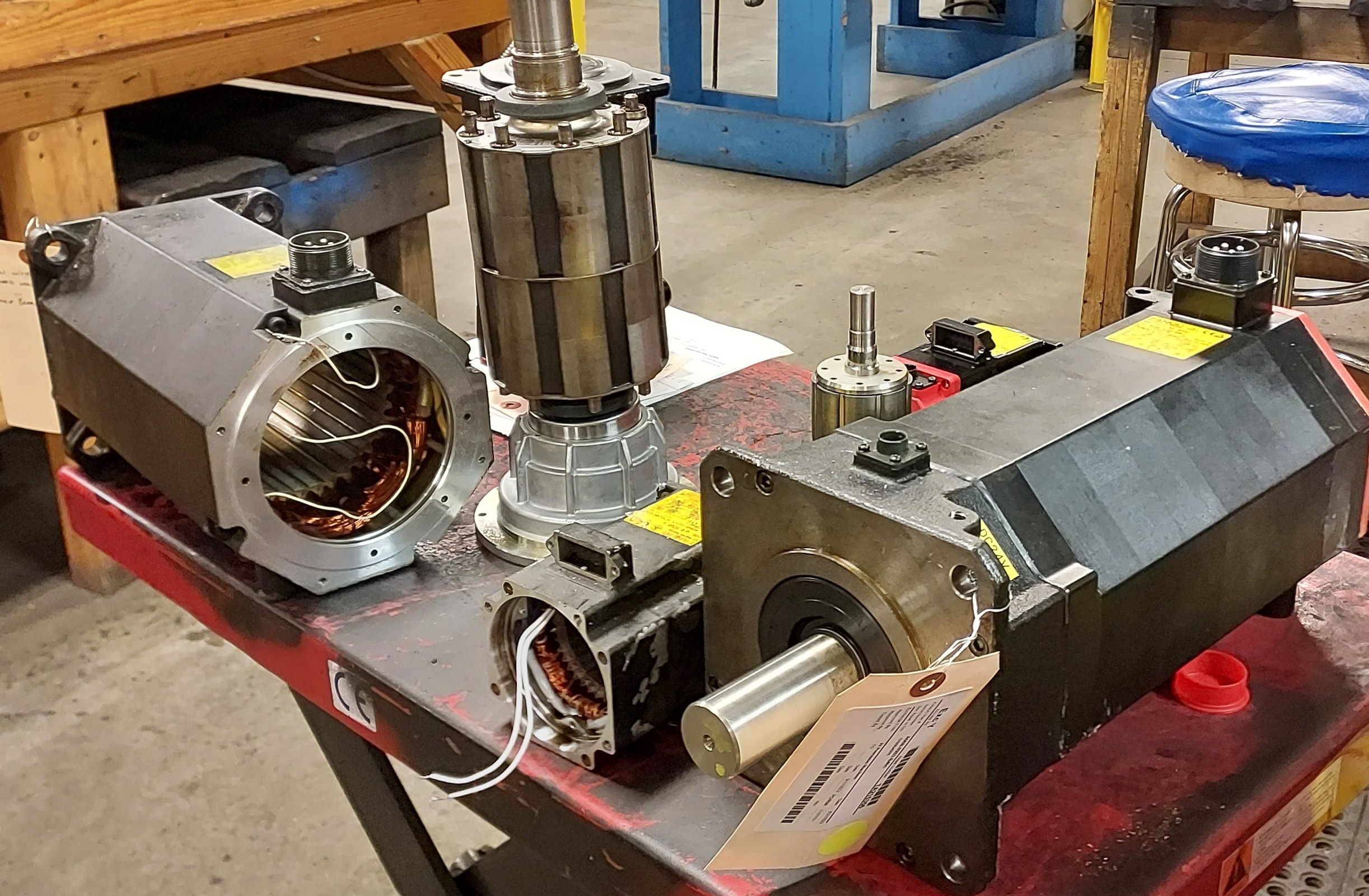
- Disassembly and initial inspection – The motor is fully disassembled, allowing every component to be individually evaluated. This is where hidden damage often surfaces for the first time.
- Component-level assessment – Rotors, encoders, resolvers, bearings, windings, and other internals are inspected against spec. Parts that fall outside of tolerance are flagged for replacement.
- Cleaning – The motor is deep-cleaned to remove contamination from years of operation. This step is critical for reliable performance after rebuild.
- Parts replacement and rebuilding – Nonconforming or worn components are replaced. Bearings are replaced as a matter of course. Windings are inspected and re-wound if needed.
- Calibration and balancing – Machined components require precise tolerances. Careful calibration at this stage is essential for accurate, repeatable performance.
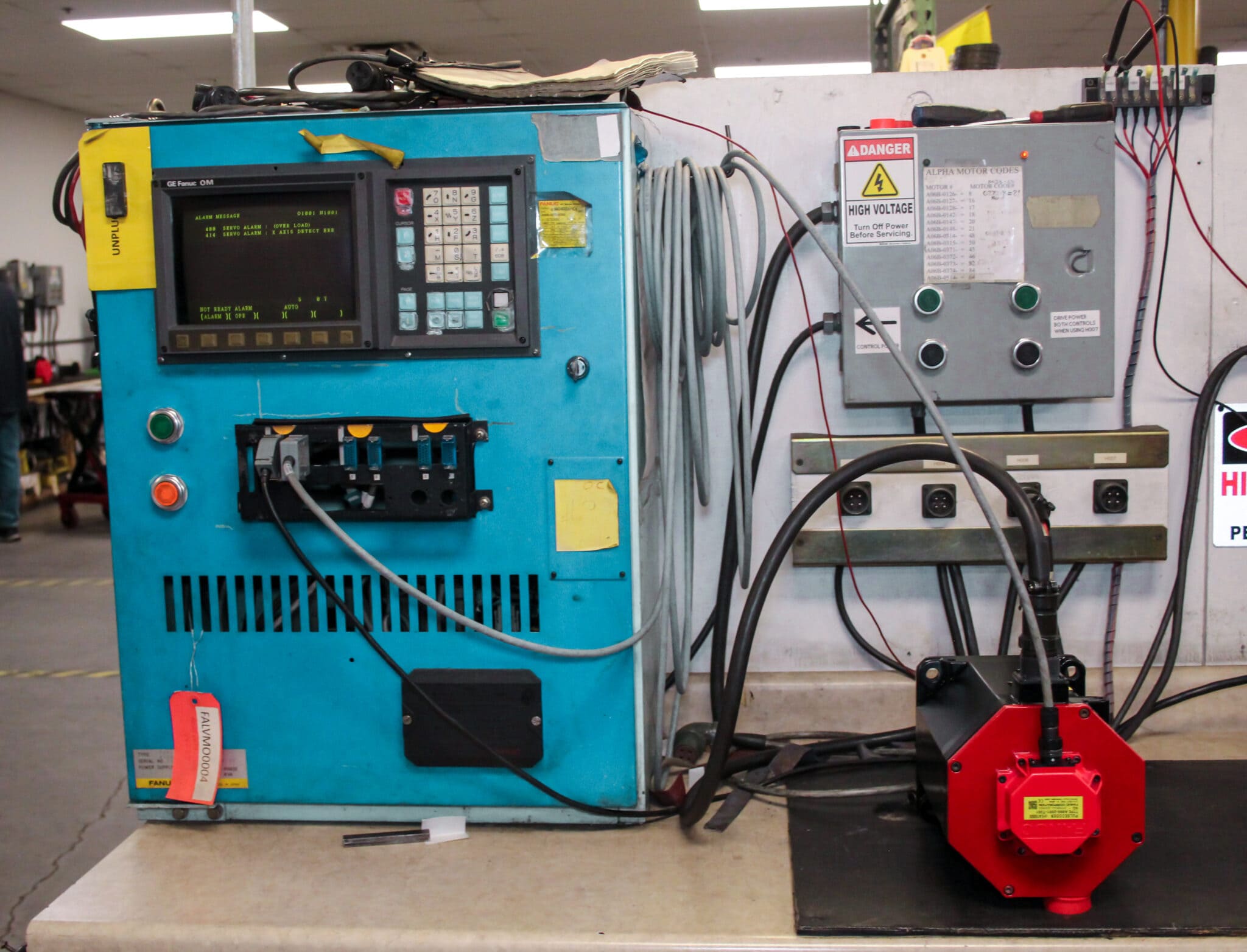
- Load testing – Every refurbished motor is tested under load using one of our more than 50 Fanuc test systems. We test in both forward and reverse to confirm reliable operation before the unit ships.
- Final inspection and packaging – The unit goes through a final quality control check, then is painted and carefully packaged so it arrives at your facility in clean, working condition.
Fanuc Drive Refurbishment: A Comparable Standard
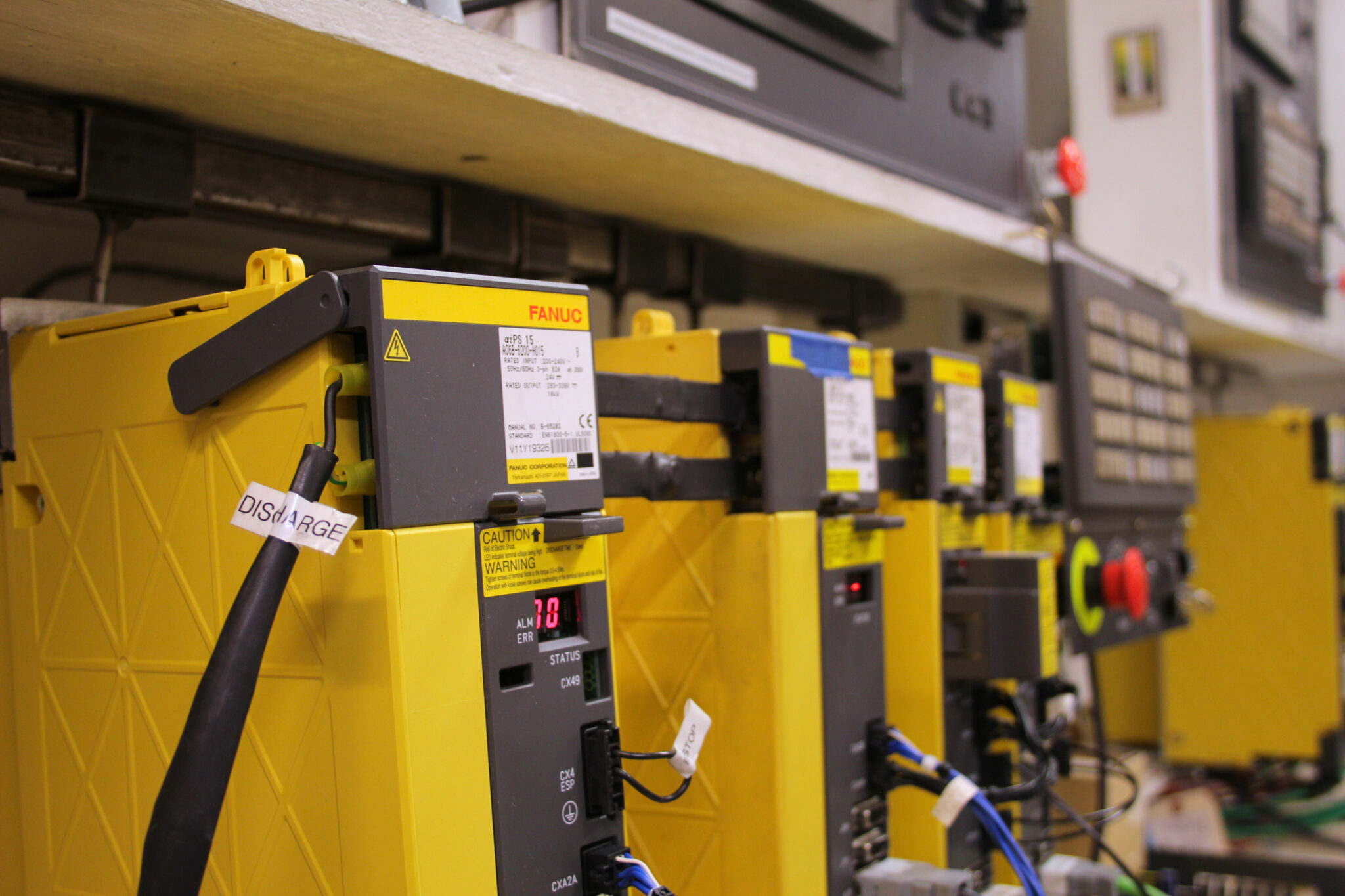
Fanuc AC servo drives and Fanuc DC servo drives undergo a comparable refurbishment process. Each drive is:
- Evaluated and tested for alignment before disassembly
- Disassembled so internal components can be individually inspected
- Rebuilt with replacement parts where needed
- Run overnight on a Fanuc control test system to confirm reliability under real operating conditions
- Cleaned, painted, and packaged for shipment
The overnight test is particularly important. A quick bench test can miss intermittent faults that only surface after sustained operation. Running the drive on an actual Fanuc control replicates real-world conditions and gives us, and you, confidence in the finished product.

Why Refurbished Doesn’t Mean Compromised
This is the concern we hear most often, and it’s a fair one. The short answer: an expertly refurbished part, tested under load against OEM specifications, performs exactly as needed.
Here’s what that means in practice. Our refurbished Fanuc servo motors and drives are restored to like-new OEM standards. They integrate with your existing CNC machines and robotic systems without modifications. There are no concerns because we test against the same specifications the part was originally built to meet.
The cost savings are real. Refurbished parts from T.I.E. Industrial can save up to 50% to 75% compared to OEM pricing, without sacrificing the performance your operation depends on. If you replace three Fanuc parts a year and would spend $18,000 on new motors, drives, and amplifiers, buying refurbished could realistically save your company $9,000 a year at no loss of reliability or quality.
Compatibility Considerations Before You Order
For maintenance managers and engineers, compatibility is a legitimate concern. A few things to keep in mind:
- Know your part number. All Fanuc servo motors carry a part number beginning with A06B. The middle section of digits refers to the motor’s winding and electrical performance specifications. The final group of letters and digits identifies feedback and shaft configuration. Two motors that look nearly identical on the outside can have meaningfully different performance profiles based on their part numbers.
- Match the feedback type. Fanuc systems use different encoder and resolver configurations across product generations. Confirm that the refurbished unit uses the same feedback interface that your control system requires.
- Verify the drive-motor pairing. Fanuc drives are matched to motor types by series. An amplifier spec’d for an AC servo axis won’t operate a DC motor correctly. When in doubt, our team can confirm compatibility before you order.
For Fanuc drive troubleshooting tips and tricks, our Fanuc drive resources hub is a useful starting point for engineers and technicians working through specific drive system questions.
Put Refurbishment To Work for Your Operation
Unplanned downtime is costly. A Fanuc servo motor or drive refurbishment by T.I.E. Industrial gives you a tested, warrantied solution that gets your equipment back in service fast, without the new-part price tag. With decades of experience, one of the largest third-party Fanuc inventories in North America, and same-day shipping on in-stock parts, we’re the resource maintenance teams and MRO buyers rely on when it counts. Browse our full inventory or request a quote. We typically respond within 15 minutes.
Frequently Asked Questions
Can a refurbished Fanuc servo motor handle the same load as a new one?
Yes, provided it has been properly refurbished and tested. A motor rebuilt to OEM specifications and tested under rated load (both forward and reverse) should perform identically to a new unit of the same part number. The key differentiator is the rigor of the refurbishment process and whether load testing was performed, not simply whether the part is new or rebuilt.
What’s the difference between a refurbished part and a repaired part?
A repaired part typically means a specific fault was identified and addressed, such as a failed encoder, a bad bearing, or a blown component. Refurbishment is a more comprehensive process that includes full disassembly and load testing. The result is a part restored to like-new functional condition rather than simply a part with its most recent fault corrected.
How do I know if my Fanuc servo drive is failing before it completely shuts down?
Fanuc alarm codes are your first line of information. Common early indicators of drive degradation include intermittent faults that clear on restart, axis following errors during acceleration or deceleration, and inconsistent torque output at steady state. Tracking alarm history in your CNC control can help identify patterns before a complete failure occurs. If you’re seeing recurring codes, it’s worth having the drive evaluated rather than waiting for a shutdown.
Is there a core exchange option for refurbished Fanuc parts?
Yes. T.I.E. Industrial offers a core exchange program that allows you to return a nonfunctioning part for credit when purchasing a refurbished replacement. This is particularly useful when a machine is down and you need a working unit immediately. You can receive the refurbished replacement and return the failed core once your equipment is back in service.
Troubleshooting Fanuc CNC FAQs about Common Issues and Solutions
Get answers to your most concerning Fanuc CNC questions.

Unveiling Precision: A Comprehensive Comparison of Fanuc Alpha and Beta Drive Series
Learn about the differences and similarities between the Fanuc Alpha and Beta drive series.
Addressing Fanuc Drive Initialization and Mastering Issues
Discover key issues related to Fanuc drive initialization and mastering.
Was this helpful?
1 / 0