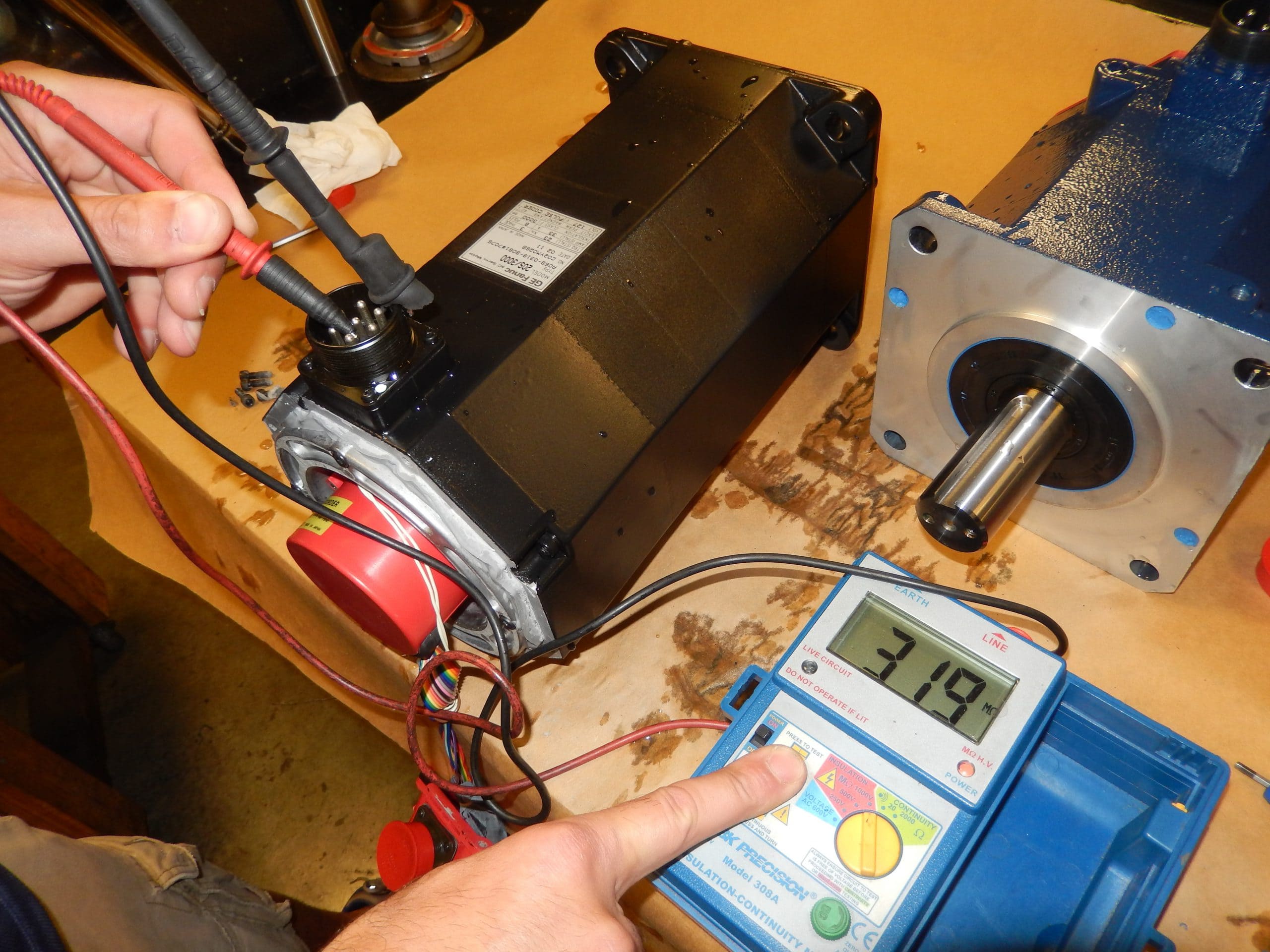
Liquid Resistant Coating Helps Preserve Fanuc Servo Motor Life
Manufacturing environments are rarely clean or forgiving. Fanuc servo motors operating in CNC machining, robotic cells, and washdown applications are constantly exposed to coolants, oils, metal shavings, and heat. Over time, these conditions can compromise internal motor components and lead to repeated failures, unplanned downtime, and costly repairs.
That’s where Liquid Resistant Coating (LRC) can help.
Why Fanuc Servo Motors Fail in Harsh Environments
Even high-quality Fanuc servo motors are vulnerable when liquids and contaminants penetrate the motor housing. Common environmental factors include:
- Cutting fluids and coolants used in CNC machining
- Oils and lubricants present in automated production lines
- Metal chips and debris generated during machining processes
- Heat that accelerates wear on internal motor components
When exposure is consistent, damage to bearings, seals, shafts, and stators becomes more likely, shortening motor service life and increasing failure frequency.
What Is Liquid Resistant Coating (LRC)?
Liquid Resistant Coating is a value-added motor repair option offered by T.I.E. Industrial to help protect Fanuc servo motors from moisture and fluid intrusion.
Using proprietary coating technology, LRC provides an added protective barrier on internal components, helping prevent liquids from reaching areas where they can cause corrosion, electrical faults, or mechanical wear. The coating process has been thoroughly tested and is designed for use in demanding industrial environments.
IP67 Protection and Liquid Resistant Coating Testing
T.I.E. Industrial liquid resistant coated motors have passed the IP67 Waterproofing Test (NEMA Rating 6), demonstrating their ability to withstand liquid exposure in harsh operating conditions.
The IP67 standard, created by the International Electrotechnical Commission (IEC), defines enclosure protection requirements. Under this standard, ingress of water in harmful quantities shall not be possible when the enclosure is immersed in water under defined conditions of pressure and time—up to 1 meter of submersion for 30 minutes.
This level of testing helps validate liquid resistant coating as a practical solution for Fanuc servo motors operating in environments where coolant, oil, or moisture exposure is unavoidable.
Benefits of Liquid Resistant Coating for Fanuc Motors
Liquid Resistant Coating is often recommended for motors that experience repeated failures or operate in wet, splash-prone, or high-heat environments. Benefits include:
- Improved resistance to coolants, oils, and liquids
- Added protection for critical internal motor components
- Extended service life in harsh manufacturing conditions
- No change to motor performance or form factor
- Compatibility with most Fanuc servo motors
Standard Fanuc Servo Motor Repair vs. Liquid Resistant Coating (LRC)
When evaluating motor repair options, it’s important to understand how a standard repair compares to a motor repaired with Liquid Resistant Coating.
| Feature | Standard Motor Repair | Motor Repair with Liquid Resistant Coating (LRC) |
|---|---|---|
| Protection from coolants and oils | Relies on original seals and housings | Added internal protection against liquid intrusion |
| Resistance to moisture exposure | Dependent on environment and installation | Improved resistance in wet or splash-prone environments |
| Internal component protection | Restores components to operating condition | Adds protective coating to internal components |
| Motor performance | No change | No change |
| Compatibility | Fanuc servo motors | Most Fanuc servo motors |
| Suitability for harsh environments | Moderate | Improved for coolant, oil, and moisture exposure |
| IP67 testing | Not applicable | Passed IP67 Waterproofing Test (NEMA Rating 6) |
This comparison helps clarify when Liquid Resistant Coating may be appropriate—particularly for motors operating in environments where liquid exposure contributes to repeat failures.
Availability and Warranty
Liquid Resistant Coating can be applied to most Fanuc servo motors, and LRC motors are currently available in stock for same-day shipment.
All liquid resistant coated motors include a one-year limited in-service warranty.
Is Liquid Resistant Coating Right for Your Application?
If your Fanuc servo motors operate in environments where liquid exposure, contamination, or excessive heat are contributing to premature failures, Liquid Resistant Coating may help improve reliability and reduce unplanned downtime.
T.I.E. Industrial can evaluate your application and failure history to determine whether LRC is an appropriate option for your motor repair or replacement needs.
Frequently Asked Questions About Liquid Resistant Coating For Fanuc Motors
What does IP67 mean for servo motors?
IP67 is an ingress protection rating established by the IEC. It indicates that the motor enclosure can withstand temporary immersion in water—up to 1 meter for 30 minutes—without allowing harmful water ingress.
Does liquid resistant coating make a motor waterproof?
Liquid resistant coating helps protect internal components from moisture intrusion but does not change how the motor is designed or installed. It provides added protection in environments where liquid exposure is common.
Can liquid resistant coating be applied to existing Fanuc servo motors?
Yes. Liquid resistant coating can be applied during the motor repair or rebuild process and is compatible with most Fanuc servo motors.
Will liquid resistant coating affect motor performance?
No. Liquid Resistant Coating does not alter motor performance, electrical characteristics, or fit.
When should liquid resistant coating be considered?
LRC is often considered for motors operating in CNC machining, washdown environments, robotic welding cells, or applications where coolant, oil, or moisture exposure contributes to repeated failures.
Was this helpful?
0 / 0